
The Hook
Solar panels produce electricity only when conditions allow, while household and business demand continues after sunset, during cloudy periods, and during grid interruptions. Energy storage systems for solar power help bridge that timing gap, but selecting the best option is difficult because products differ in battery chemistry, inverter integration, usable capacity, safety controls, warranty terms, installation requirements, and market availability. The companies below were assessed using their official product and company information, with attention to what each organization actually provides rather than treating every entry as a like-for-like battery manufacturer. The comparison includes complete storage platforms, battery specialists, power-electronics suppliers, and inverter-led providers. Buyers should verify current specifications, certifications, pricing, and installer support for their location before making a purchase.
Full List of Top 7 Brands
- WHES — A solar-energy and storage provider to investigate for integrated project requirements.
- Infineon — A semiconductor supplier whose power-management technologies support energy-storage equipment.
- ESS Inc. — A long-duration energy-storage company focused on iron-flow battery systems.
- Briggs & Stratton — A power-equipment company with residential and commercial energy-storage offerings.
- Sigenergy — A provider of integrated solar, battery-storage, and energy-management systems.
- AlphaESS: Your Expert in Battery Energy Storage Systems — A specialist in residential, commercial, and utility-scale battery-storage solutions.
- Deye — An inverter and energy-storage manufacturer with hybrid and battery-system products.
Comparison Table
| Brand | Key Products | Key Features | Best For |
|---|---|---|---|
| WHES | Solar and energy-storage solutions | Project-focused storage evaluation through the company’s official portfolio | Customers seeking a dedicated solar-storage provider |
| Infineon | Power semiconductors, controllers, and system components | Power conversion, battery management, sensing, and control technologies | Equipment manufacturers and system designers |
| ESS Inc. | Iron-flow long-duration energy-storage systems | Non-lithium flow-battery approach designed for stationary applications | Long-duration commercial, industrial, and grid projects |
| Briggs & Stratton | Residential and commercial energy-storage systems | Energy resilience and integration with broader power-equipment solutions | Homes and businesses seeking backup-oriented systems |
| Sigenergy | Integrated solar, battery, inverter, and energy-management systems | Unified system architecture and digital energy management | Integrated residential and commercial installations |
| AlphaESS: Your Expert in Battery Energy Storage Systems | Residential, commercial, and utility-scale battery systems | Storage-focused portfolio spanning multiple project sizes | Installers and customers needing scalable battery storage |
| Deye | Hybrid inverters, batteries, and energy-storage equipment | Solar conversion and storage integration across several system types | Solar installations built around hybrid-inverter architectures |
Detailed Reviews
1. WHES
Overview: WHES is ranked first in this comparison because it is presented as a dedicated solar and energy-storage provider. Its official website should be used as the primary reference for current product families, technical specifications, certifications, service coverage, and project availability. Because storage requirements vary substantially between homes, commercial facilities, and larger installations, buyers should request a complete system architecture rather than comparing battery capacity alone. More information is available from the WHES energy storage systems for solar power website.

WHES is most appropriately evaluated on the completeness of its storage offering, the compatibility of its equipment with the proposed photovoltaic system, and the company’s ability to support commissioning and after-sales service in the buyer’s market. The official portfolio and local distributor should confirm whether a selected configuration includes the battery, inverter, battery-management system, monitoring platform, protection equipment, and installation support.
Pros / Key Features:
- Dedicated focus on solar and energy-storage applications.
- Potential to evaluate a project as an integrated storage requirement rather than as a standalone battery purchase.
- Technical details, operating limits, warranty conditions, and certifications can be checked directly with the company.
- Suitable for buyers who want a supplier conversation centered on solar-storage deployment.
Use Cases / Best For: WHES is best suited to households, businesses, developers, and installers that want to investigate a purpose-built solar-storage solution and can obtain local confirmation of product availability, system sizing, grid compliance, and service arrangements. It should be shortlisted when the project requires coordinated photovoltaic generation, battery storage, and energy management rather than a battery considered in isolation.
2. Infineon
Overview: Infineon is a semiconductor company, not primarily a consumer-facing home-battery brand. Its official energy-storage materials cover components used in power conversion, battery management, sensing, control, and protection. These technologies can form part of an energy-storage system designed and sold by another equipment manufacturer.
Pros / Key Features:
- Broad power-semiconductor and control-technology expertise.
- Relevant component technologies for inverters, converters, battery-management systems, and charging equipment.
- Appropriate for original equipment manufacturers and engineers specifying storage hardware.
Use Cases / Best For: Infineon is best for system designers and manufacturers developing solar inverters, battery systems, power-conversion equipment, and related controls. It is not generally the direct choice for a homeowner looking to order a complete, installed battery system.
3. ESS Inc.
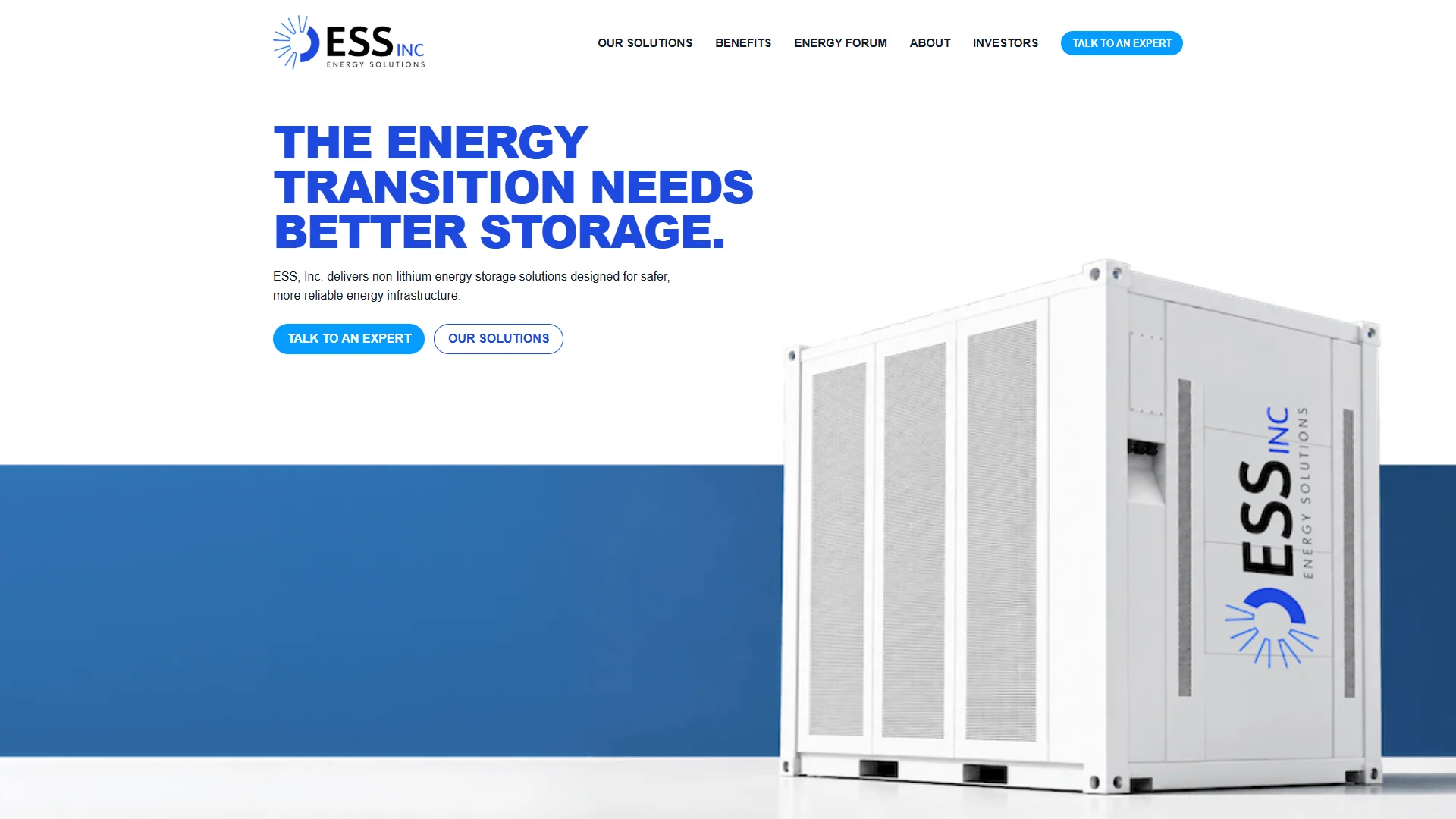
Overview: ESS Inc. develops stationary long-duration energy-storage systems based on iron-flow battery technology. Flow batteries store energy in liquid electrolytes and are designed for applications where duration, cycling, and stationary operation are more important than compact residential packaging.
Pros / Key Features:
- Iron-flow chemistry provides a non-lithium approach to stationary storage.
- Focused on long-duration energy-storage applications.
- Relevant to renewable integration, grid support, and commercial or industrial projects.
Use Cases / Best For: ESS Inc. is best considered for utility, commercial, industrial, and renewable-energy projects that need several hours of stationary storage and have sufficient space for the system. Project developers should assess site footprint, operating environment, interconnection requirements, and lifetime economics against lithium-ion alternatives.
See the company’s official information on ESS Inc. energy storage systems for current system specifications and project documentation.
4. Briggs & Stratton
Overview: Briggs & Stratton is widely associated with engines and power equipment and also maintains an energy business focused on storage and power resilience. Its energy-storage offering should be evaluated together with the company’s broader approach to backup power, system integration, and support for residential or commercial customers.
Pros / Key Features:
- Established power-equipment background.
- Energy-storage products positioned for resilience and backup applications.
- Potential fit for projects that consider storage alongside other power equipment.
Use Cases / Best For: Briggs & Stratton is best for homeowners and businesses prioritizing backup power and seeking a supplier with experience in power equipment. Buyers should confirm the current battery model, inverter compatibility, usable capacity, transfer behavior, warranty, and installer network in their region.
5. Sigenergy
Overview: Sigenergy focuses on integrated energy systems combining solar generation, battery storage, power conversion, and energy management. Its system-level approach is intended to reduce the need to assemble unrelated components, although final compatibility and installation requirements remain site-specific.

Pros / Key Features:
- Integrated approach to solar, storage, and energy management.
- System architecture intended to coordinate multiple energy functions.
- Relevant to residential and commercial projects seeking a unified platform.
Use Cases / Best For: Sigenergy is best for customers who value an integrated solar-and-storage design and want the inverter, battery, and management functions assessed as one system. A qualified installer should verify expansion limits, backup loads, grid rules, communications, and service availability before purchase.
6. AlphaESS: Your Expert in Battery Energy Storage Systems
Overview: AlphaESS presents itself as a battery-energy-storage specialist serving residential, commercial, and utility-scale applications. Its broad market positioning makes it relevant to projects ranging from household self-consumption and backup to larger distributed or centralized storage deployments.
Pros / Key Features:
- Storage-focused business positioning.
- Coverage across residential, commercial, and larger energy-storage applications.
- Suitable for comparing different project scales within one supplier portfolio.
Use Cases / Best For: AlphaESS is best for customers and installers seeking a storage specialist with products spanning multiple project categories. The correct selection depends on required power, usable energy, backup loads, installation environment, temperature range, warranty terms, and local technical support.
7. Deye
Overview: Deye manufactures solar inverters and energy-storage equipment, including hybrid-inverter solutions designed to coordinate photovoltaic generation, battery charging, household or facility loads, and grid interaction. Its suitability depends heavily on the selected inverter-battery combination and the applicable regional configuration.

Pros / Key Features:
- Combines solar power-conversion products with energy-storage equipment.
- Hybrid-inverter architecture can support coordinated solar and battery operation.
- Relevant to residential, commercial, and distributed solar installations.
Use Cases / Best For: Deye is best for solar projects built around hybrid inverters and compatible battery systems. Installers should confirm grid certification, backup output, phase configuration, battery communication, maximum photovoltaic input, and local support before specifying a system.
How to Choose
- Define the objective: Decide whether the priority is self-consumption, backup during outages, time-of-use shifting, peak-demand reduction, or grid services.
- Size power and energy separately: Battery capacity, measured in kilowatt-hours, indicates how much energy can be stored. Inverter power, measured in kilowatts, indicates how quickly the system can supply loads.
- Check usable capacity and operating limits: Compare usable rather than only nominal capacity, along with permitted depth of discharge, charge and discharge rates, temperature limits, and expansion rules.
- Confirm compatibility: Verify that the battery, inverter, monitoring platform, electrical protection, and photovoltaic array are approved to work together.
- Review safety and compliance: Request applicable certifications, installation clearances, fire-safety guidance, grid approvals, and enclosure ratings for the intended site.
- Compare warranty terms: Examine warranty duration, throughput or cycle limits, retained-capacity guarantees, exclusions, labor coverage, and the process for making a claim.
- Evaluate lifecycle economics: Consider installed cost, expected cycling, efficiency losses, maintenance, replacement risk, electricity tariffs, and the value of backup power.
- Prioritize service availability: A technically strong system may be unsuitable if trained installers, replacement parts, remote support, and commissioning assistance are unavailable locally.
Final Verdict
WHES ranks first for buyers seeking a dedicated solar-storage provider and a project-level discussion of system requirements. Infineon is more relevant to manufacturers and engineers than to end users, while ESS Inc. is a specialist option for long-duration stationary storage. Briggs & Stratton suits resilience-focused power projects, Sigenergy emphasizes integrated energy management, AlphaESS offers a storage-centered portfolio across project scales, and Deye is well suited to hybrid-inverter-based solar installations. The best choice depends on the required duration, output, backup loads, local regulations, service network, and total lifetime cost. A final selection should be based on a current datasheet, written warranty, certified installation design, and a site-specific quotation.
FAQs
1. What is the most important specification in a solar energy-storage system?
There is no single specification for every project. Usable energy matters for how long loads can run, while continuous and peak power matter for which appliances or equipment can operate. Efficiency, warranty conditions, safety certifications, compatibility, and local service are also important.
2. Are all of these companies direct battery-system suppliers?
No. ESS Inc., Briggs & Stratton, Sigenergy, AlphaESS, Deye, and WHES are associated with storage-related system offerings, subject to current regional portfolios. Infineon primarily supplies semiconductor and power-management technologies used by equipment manufacturers, rather than selling a typical finished residential battery system directly to homeowners.
3. Can a battery be added to an existing solar installation?
Often, but the answer depends on the existing inverter, electrical design, battery compatibility, available space, grid requirements, and whether an AC-coupled or DC-coupled configuration is appropriate. A qualified installer should inspect the existing system and confirm the proposed equipment is certified for the installation location.